turn-by-turn navigation

| Wednesday, December 14, 2011

Turn-by-turn navigation is a feature of some GPS navigation devices where directions for a selected route are continually presented to the user in the form of spoken and visual instructions. The system keeps the user up-to-date about the best route to the destination, and is often updated according to changing factors such as traffic and road conditions. Turn-by-turn systems typically use an electronic voice to inform the user whether to turn left or right, the street name, and how much distance to the turn.


#http://en.wikipedia.org

microSDHC

|

SD cardsSecure Digital (SD) is a non-volatile memory card format developed by the SD Card Association (SDA) for use in portable devices. The SD technology is used by more than 400 brands across dozens of product categories and more than 8,000 models, and is considered the de-facto industry standard.
SD now comprises several families of cards: the original, Standard-Capacity (SDSC) card, a High-Capacity (SDHC) card family, an eXtended-Capacity (SDXC) card family, and the SDIO family with input/output functions rather than just data storage.
SD also comprises three different form factors: the original size, the "mini" size, and the "micro" size (see illustration). Electrically passive adaptors allow the use of a smaller card in a host device built to hold a larger card. There are many combinations of form factors and device families.
Host devices that comply with newer versions of the specification provide backward compatibility and accept older SD cards, but older host devices do not recognize newer cards. The SDA uses several trademarked logos to enforce compliance with its specifications and assure users of compatibility. This article explains several factors that can prevent the use of a newer SD card:
  • A newer card may offer greater capacity than the host device can handle
  • A newer card may use a file system the host device cannot navigate
  • Use of an SDIO card requires the host device be designed for the input/output functions the card provides
  • The organization of the card was changed starting with the SDHC family
  • Some vendors produced SDSC cards above 1 GB before the SDA had standardized a method of doing so.
 #http://en.wikipedia.org

touchscreen

|


A touchscreen is an electronic visual display that can detect the presence and location of a touch within the display area. The term generally refers to touching the display of the device with a finger or hand. Touchscreens can also sense other passive objects, such as a stylus. Touchscreens are common in devices such as all-in-one computers, tablet computers, and smartphones.
The touchscreen has two main attributes. First, it enables one to interact directly with what is displayed, rather than indirectly with a pointer controlled by a mouse or touchpad. Secondly, it lets one do so without requiring any intermediate device that would need to be held in the hand. Such displays can be attached to computers, or to networks as terminals. They also play a prominent role in the design of digital appliances such as the personal digital assistant (PDA), satellite navigation devices, mobile phones, and video games.

 #http://en.wikipedia.org

digital camera

|

A digital camera (or digicam) is a camera that takes video or still photographs, or both, digitally by recording images via an electronic image sensor. It is the main device used in the field of digital photography. Most 21st century cameras are digital.Front and back of Canon PowerShot A95
Digital cameras can do things film cameras cannot: displaying images on a screen immediately after they are recorded, storing thousands of images on a single small memory device, and deleting images to free storage space. The majority, including most compact cameras, can record moving video with sound as well as still photographs. Some can crop and stitch pictures and perform other elementary image editing. Some have a GPS receiver built in, and can produce Geotagged photographs.
The optical system works the same as in film cameras, typically using a lens with a variable diaphragm to focus light onto an image pickup device. The diaphragm and shutter admit the correct amount of light to the imager, just as with film but the image pickup device is electronic rather than chemical. Most digicams, apart from camera phones and a few specialized types, have a standard tripod screw.
Digital cameras are incorporated into many devices ranging from PDAs and mobile phones (called camera phones) to vehicles. The Hubble Space Telescope and other astronomical devices are essentially specialized digital cameras.

 #http://en.wikipedia.org

megapixel

|

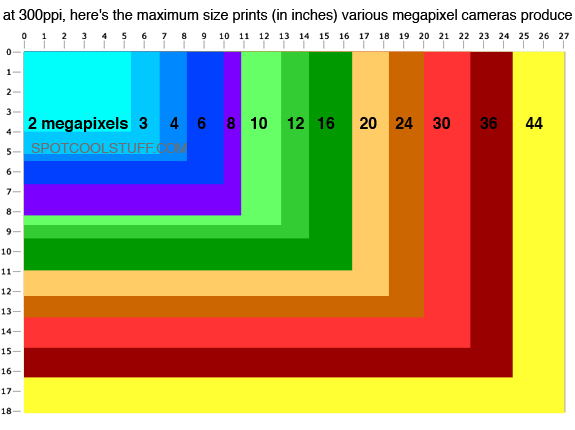
http://tech.spotcoolstuff.com/wp-content/uploads/2008/12/pixsize.jpg
A megapixel (MP or Mpx) is one million pixels, and is a term used not only for the number of pixels in an image, but to express the number of image sensor elements of digital cameras or the number of display elements of digital displays. For example, a camera with an array of 2048 × 1536 sensor elements is commonly said to have "3.1 megapixels" (2048 × 1536 = 3,145,728).
Digital cameras use photosensitive electronics, either charge-coupled device (CCD) or complementary metal–oxide–semiconductor (CMOS) image sensors, consisting of a large number of single sensor elements, each of which records a measured intensity level. In most digital cameras, the sensor array is covered with a patterned color filter mosaic having red, green, and blue regions in the Bayer filter arrangement, so that each sensor element can record the intensity of a single primary color of light. The camera interpolates the color information of neighboring sensor elements, through a process called demosaicing, to create the final image. These sensor elements are often called "pixels", even though they only record 1 channel (only red, or green, or blue) of the final color image. Thus, two of the three color channels for each sensor must be interpolated and a so-called N-megapixel camera that produces an N-megapixel image provides only one-third of the information that an image of the same size could get from a scanner. Thus, certain color contrasts may look fuzzier than others, depending on the allocation of the primary colors (green has twice as many elements as red or blue in the Bayer arrangement).

#http://en.wikipedia.org

Wi-Fi

|

Wi-Fi or Wifi, is a mechanism for wirelessly connecting electronic devices. A device enabled with Wi-Fi, such as a personal computer, video game console, smartphone, or digital audio player, can connect to the Internet via a wireless network access point. An access point (or hotspot) has a range of about 20 meters (65 ft) indoors and a greater range outdoors. Multiple overlapping access points can cover large areas.
A Wi-Fi enabled device such as a PC, smartphone, tablet or games console, can connect to the Internet when within range of a hotspot. Hotspot coverage can comprise an area as small as a single room with wireless-opaque walls or as large as many square miles covered by overlapping access points. "Wi-Fi" is a trademark of the Wi-Fi Alliance and the brand name for products using the IEEE 802.11 family of standards. Wi-Fi products that complete Wi-Fi Alliance interoperability certification testing successfully may use the "Wi-Fi CERTIFIED" designation and trademark.

 #http://en.wikipedia.org

Verizon Wireless

| Monday, December 12, 2011


Verizon Wireless logoCellco Partnership Inc., doing business as Verizon Wireless, is one of the largest mobile network operators in the United States. The network has 107.7 million subscribers as of 2011, making it the largest wireless service provider in America.
Headquartered in Basking Ridge, New Jersey, the company is a joint venture of U.S. telecommunications firm Verizon Communications and UK multinational mobile network operator Vodafone, with 55 and 45 percent ownership respectively. On January 9, 2009, Verizon Wireless acquired Alltel Wireless in a deal valued at $28.1 billion. The acquisition expanded Verizon's wireless network.


#http://en.wikipedia.org

Powered by Blogger.

Popular Posts

Search This Blog