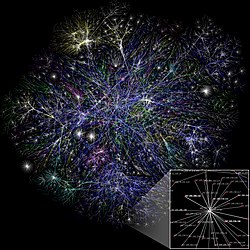
Most traditional communications media including telephone, music, film, and television are reshaped or redefined by the Internet, giving birth to new services such as Voice over Internet Protocol (VoIP) and IPTV. Newspaper, book and other print publishing are adapting to Web site technology, or are reshaped into blogging and web feeds. The Internet has enabled or accelerated new forms of human interactions through instant messaging, Internet forums, and social networking. Online shopping has boomed both for major retail outlets and small artisans and traders. Business-to-business and financial services on the Internet affect supply chains across entire industries.
The origins of the Internet reach back to research of the 1960s, commissioned by the United States government
in collaboration with private commercial interests to build robust,
fault-tolerant, and distributed computer networks. The funding of a new
U.S. backbone by the National Science Foundation
in the 1980s, as well as private funding for other commercial
backbones, led to worldwide participation in the development of new
networking technologies, and the merger of many networks. The commercialization
of what was by the 1990s an international network resulted in its
popularization and incorporation into virtually every aspect of modern
human life. As of 2011, more than 2.1 billion people – nearly a third of
Earth's population – use the services of the Internet.
The Internet has no centralized governance in either technological
implementation or policies for access and usage; each constituent
network sets its own standards. Only the overreaching definitions of the
two principal name spaces in the Internet, the Internet Protocol address space and the Domain Name System, are directed by a maintainer organization, the Internet Corporation for Assigned Names and Numbers (ICANN). The technical underpinning and standardization of the core protocols (IPv4 and IPv6) is an activity of the Internet Engineering Task Force
(IETF), a non-profit organization of loosely affiliated international
participants that anyone may associate with by contributing technical
expertise.
#http://en.wikipedia.org
Popular Posts
-
A megapixel (MP or Mpx) is one million pixels, and is a term used not only for the number of pixels in an image, but to express the numb...
-
A touchscreen is an electronic visual display that can detect the presence and location of a touch within the display area. The term g...
-
In filmmaking and video production, footage is the raw, unedited material as it had been originally filmed by movie camera or recorded by a...
-
GSM ( Global System for Mobile Communications , originally Groupe Spécial Mobile ), is a standard set developed by the European Telecommun...
-
A smartphone is a high-end mobile phone built on a mobile computing platform, with more advanced computing ability and connectivity than a...
-
Lucasfilm Limited is an American film production company founded by George Lucas in 1971, based in San Francisco, California. Lucas is the...
-
In the fields of information science, communication, and industrial design, there is debate over the meaning of interactivity . In the ...
-
QWERTY is the most common modern-day keyboard layout. The name comes from the first six letters (keys) appearing in the topleft letter r...
-
Europe ( pronunciation: / ˈ jʊər ə p / yewr -əp or / ˈ j ɜr ə p / yur -əp ) is, by convention, one of the world's seven continents...


0 comments:
Post a Comment