- GPS-based services
- WLAN-, WiFi-based services
- Cell transmitter-based services
Google Maps Navigation
Motorola Droid | Wednesday, December 14, 2011
hearing aid compatibility
Motoblur
OMAP
QWERTY
sliding
#http://en.wikipedia.org
Google Maps
turn-by-turn navigation
microSDHC
- A newer card may offer greater capacity than the host device can handle
- A newer card may use a file system the host device cannot navigate
- Use of an SDIO card requires the host device be designed for the input/output functions the card provides
- The organization of the card was changed starting with the SDHC family
- Some vendors produced SDSC cards above 1 GB before the SDA had standardized a method of doing so.
touchscreen
The touchscreen has two main attributes. First, it enables one to interact directly with what is displayed, rather than indirectly with a pointer controlled by a mouse or touchpad. Secondly, it lets one do so without requiring any intermediate device that would need to be held in the hand. Such displays can be attached to computers, or to networks as terminals. They also play a prominent role in the design of digital appliances such as the personal digital assistant (PDA), satellite navigation devices, mobile phones, and video games.
#http://en.wikipedia.org
digital camera
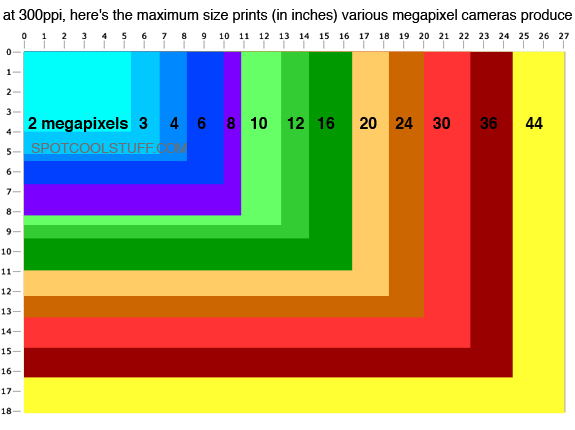
megapixel
Wi-Fi
Verizon Wireless
Motorola Droid | Monday, December 12, 2011
Cellco Partnership Inc., doing business as Verizon Wireless, is one of the largest mobile network operators in the United States. The network has 107.7 million subscribers as of 2011, making it the largest wireless service provider in America.
Headquartered in Basking Ridge, New Jersey, the company is a joint venture of U.S. telecommunications firm Verizon Communications and UK multinational mobile network operator Vodafone, with 55 and 45 percent ownership respectively. On January 9, 2009, Verizon Wireless acquired Alltel Wireless in a deal valued at $28.1 billion. The acquisition expanded Verizon's wireless network.
#http://en.wikipedia.org
Lucasfilm
Lucasfilm Limited is an American film production company founded by George Lucas in 1971, based in San Francisco, California. Lucas is the company's current chairman and CEO, and Micheline Chau is the president and COO.
The company is best known for producing the Star Wars films, and has also produced other box office hits, including the Indiana Jones franchise and American Graffiti. It has also been a leader in developing new film technology in special effects, sound, and computer animation,
and because of their expertise its subsidiaries often help produce
non-Lucasfilm pictures. Lucasfilm is set to move away from films and
more into TV, due to rising budgets.
On July 8, 2005, Lucasfilm's marketing, online, and licensing units moved into the new Letterman Digital Arts Center located in the Presidio in San Francisco. It shares the complex with Industrial Light & Magic and LucasArts. They are also best known for The Deep Note and THX.
Lucasfilm has collaborated with the Walt Disney Company and Walt Disney Imagineering numerous times to create rides and attractions centered on Star Wars and Indiana Jones for various Walt Disney Parks and Resort attractions worldwide.
#http://en.wikipedia.org
Europe
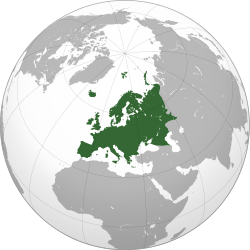
Europe (pronunciation: /ˈjʊərəp/ yewr-əp or /ˈjɜrəp/ yur-əp) is, by convention, one of the world's seven continents. Comprising the westernmost peninsula of Eurasia, Europe is generally 'divided' from Asia to its east by the watershed divides of the Ural and Caucasus Mountains, the Ural River, the Caspian and Black Seas, and the waterways connecting the Black and Aegean Seas. Europe is bordered by the Arctic Ocean and other bodies of water to the north, the Atlantic Ocean to the west, the Mediterranean Sea to the south, and the Black Sea and connected waterways to the southeast. Yet the borders of Europe—a concept dating back to classical antiquity—are somewhat arbitrary, as the primarily physiographic term "continent" can incorporate cultural and political elements.
Europe is the world's second-smallest
continent by surface area, covering about 10,180,000 square kilometres
(3,930,000 sq mi) or 2% of the Earth's surface and about 6.8% of its
land area. Of Europe's approximately 50 states, Russia is the largest by both area and population (although the country has territory in both Europe and Asia), while the Vatican City is the smallest. Europe is the third-most populous continent after Asia and Africa, with a population of 733 million or about 11% of the world's population.
Europe, in particular Ancient Greece, is the birthplace of Western culture. It played a predominant role in global affairs from the 16th century onwards, especially after the beginning of colonialism. Between the 16th and 20th centuries, European nations controlled at various times the Americas, most of Africa, Oceania, and large portions of Asia. Both World Wars were largely focused upon Europe, greatly contributing to a decline in Western European dominance in world affairs by the mid-20th century as the United States and Soviet Union took prominence. During the Cold War, Europe was divided along the Iron Curtain between NATO in the west and the Warsaw Pact in the east. European integration led to the formation of the Council of Europe and the European Union in Western Europe, both of which have been expanding eastward since the fall of the Soviet Union in 1991.
#http://en.wikipedia.org
Latin America
Latin America (Spanish: América Latina or Latinoamérica; Portuguese: América Latina; French: Amérique latine) is a region of the Americas where Romance languages (i.e., those derived from Latin) – particularly Spanish and Portuguese, and variably French – are primarily spoken. Latin America has an area of approximately 21,069,500 km² (7,880,000 sq
mi), almost 3.9% of the Earth's surface or 14.1% of its land surface
area. As of 2010, its population was estimated at more than 590 million and its combined GDP at 5.16 trillion United States dollars (6.27 trillion at PPP). The Latin American expected economic growth rate
is at about 5.7% for 2010 and 4% in 2011.
#http://en.wikipedia.org
smartphone
A smartphone is a high-end mobile phone built on a mobile computing platform, with more advanced computing ability and connectivity than a contemporary feature phone. The first smartphones were devices that mainly combined the functions of a personal digital assistant (PDA) and a mobile phone or camera phone. Today's models also serve to combine the functions of portable media players, low-end compact digital cameras, pocket video cameras, and GPS navigation units. Modern smartphones typically also include high-resolution touchscreens, web browsers
that can access and properly display standard web pages rather than
just mobile-optimized sites, and high-speed data access via Wi-Fi and mobile broadband.
The most common mobile operating systems (OS) used by modern smartphones include Google's Android, Apple's iOS, Microsoft's Windows Phone, Nokia's Symbian, RIM's BlackBerry OS, and embedded Linux distributions such as Maemo and MeeGo.
Such operating systems can be installed on many different phone models,
and typically each device can receive multiple OS software updates over
its lifetime.
The distinction between smartphones and feature phones can be vague
and there is no official definition for what constitutes the difference
between them. One of the most significant differences is that the
advanced application programming interfaces (APIs) on smartphones for running third-party applications
can allow those applications to have better integration with the
phone's OS and hardware than is typical with feature phones. In
comparison, feature phones more commonly run on proprietary firmware, with third-party software support through platforms such as Java ME or BREW.
An additional complication in distinguishing between smartphones and
feature phones is that over time the capabilities of new models of
feature phones can increase to exceed those of phones that had been
promoted as smartphones in the past.
#http://en.wikipedia.org
multimedia
|
|
|
|
|
|
|
|
#http://en.wikipedia.org
Internet
Motorola Droid | Friday, December 9, 2011
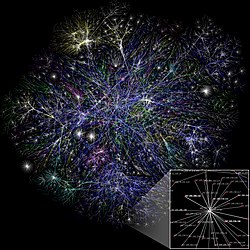
The Internet is a global system of interconnected computer networks that use the standard Internet protocol suite (TCP/IP) to serve billions of users worldwide. It is a network of networks
that consists of millions of private, public, academic, business, and
government networks, of local to global scope, that are linked by a
broad array of electronic, wireless and optical networking technologies.
The Internet carries a vast range of information resources and services, such as the inter-linked hypertext documents of the World Wide Web (WWW) and the infrastructure to support email.
Most traditional communications media including telephone, music, film, and television are reshaped or redefined by the Internet, giving birth to new services such as Voice over Internet Protocol (VoIP) and IPTV. Newspaper, book and other print publishing are adapting to Web site technology, or are reshaped into blogging and web feeds. The Internet has enabled or accelerated new forms of human interactions through instant messaging, Internet forums, and social networking. Online shopping has boomed both for major retail outlets and small artisans and traders. Business-to-business and financial services on the Internet affect supply chains across entire industries.
The origins of the Internet reach back to research of the 1960s, commissioned by the United States government
in collaboration with private commercial interests to build robust,
fault-tolerant, and distributed computer networks. The funding of a new
U.S. backbone by the National Science Foundation
in the 1980s, as well as private funding for other commercial
backbones, led to worldwide participation in the development of new
networking technologies, and the merger of many networks. The commercialization
of what was by the 1990s an international network resulted in its
popularization and incorporation into virtually every aspect of modern
human life. As of 2011, more than 2.1 billion people – nearly a third of
Earth's population – use the services of the Internet.
The Internet has no centralized governance in either technological
implementation or policies for access and usage; each constituent
network sets its own standards. Only the overreaching definitions of the
two principal name spaces in the Internet, the Internet Protocol address space and the Domain Name System, are directed by a maintainer organization, the Internet Corporation for Assigned Names and Numbers (ICANN). The technical underpinning and standardization of the core protocols (IPv4 and IPv6) is an activity of the Internet Engineering Task Force
(IETF), a non-profit organization of loosely affiliated international
participants that anyone may associate with by contributing technical
expertise.
#http://en.wikipedia.org
Popular Posts
-
A megapixel (MP or Mpx) is one million pixels, and is a term used not only for the number of pixels in an image, but to express the numb...
-
A touchscreen is an electronic visual display that can detect the presence and location of a touch within the display area. The term g...
-
In filmmaking and video production, footage is the raw, unedited material as it had been originally filmed by movie camera or recorded by a...
-
GSM ( Global System for Mobile Communications , originally Groupe Spécial Mobile ), is a standard set developed by the European Telecommun...
-
A smartphone is a high-end mobile phone built on a mobile computing platform, with more advanced computing ability and connectivity than a...
-
Lucasfilm Limited is an American film production company founded by George Lucas in 1971, based in San Francisco, California. Lucas is the...
-
In the fields of information science, communication, and industrial design, there is debate over the meaning of interactivity . In the ...
-
QWERTY is the most common modern-day keyboard layout. The name comes from the first six letters (keys) appearing in the topleft letter r...
-
Europe ( pronunciation: / ˈ jʊər ə p / yewr -əp or / ˈ j ɜr ə p / yur -əp ) is, by convention, one of the world's seven continents...