Showing posts with label Google. Show all posts

Google Maps

| Wednesday, December 14, 2011

Google Maps directions.pngGoogle Maps (formerly Google Local) is a web mapping service application and technology provided by Google, free (for non-commercial use), that powers many map-based services, including the Google Maps website, Google Ride Finder, Google Transit, and maps embedded on third-party websites via the Google Maps API. It offers street maps, a route planner for traveling by foot, car, bike (beta) or public transport and an urban business locator for numerous countries around the world. Google Maps satellite images are not updated in real time; they are several months or years old.
Google Maps uses a close variant of the Mercator projection, so it cannot show areas around the poles. A related product is Google Earth, a stand-alone program which offers more globe-viewing features, including showing polar areas.

 #http://en.wikipedia.org

censorship

| Wednesday, November 30, 2011

Censorship is the suppression of speech or other public communication which may be considered objectionable, harmful, sensitive, or inconvenient to the general body of people as determined by a government, media outlet, or other controlling body.


#from http://en.wikipedia.org

BrandZ

|

BrandZ is a brand equity database. It holds data from over 650,000 consumers and professionals across 31 countries, comparing over 23,000 brands. The database is used to estimate brand valuations, and each year since 2006, has been used to generate a list of the top 100 global brands.
According to BrandZ, "Brand value is the financial value of a brand defined as the sum of all earnings that a brand is expected to generate." BrandZ collects data annually from consumers, with each person asked to evaluate brands in a competitive context from a category they shop in. This yields opinions from people who know the category and therefore can judge a brand based on the attributes that are important to them. Sectors covered include: consumer packaged goods (FMCG), retail/e-commerce, long purchase cycle brands, service, and corporate. Using this data, BrandZ attempts to compute numbers which quantify the degree of consumer loyalty to each brand, and the brands' growth potentials.
The credibility of the Interbrand and BrandZ league tables have been cast into doubt by an article written in Marketing Week by Mark Ritson . The lack of clear definitions and valuation dates in the both companies methodology raise questions about the subjectivity involved in brand valuations. Being part of multinational advertising groups, Interbrand and Millward Brown also suffer from the risk of objectivity. Transparency and objectivity are two of the requirements of the ISO 10668 standard of monetary brand valuations.

#from http://en.wikipedia.org

Blogger

|


  • A person who writes a blog, or weblog
  • Blogger (service), a web service for publishing blogs
#from http://en.wikipedia.org

YouTube

|

Logo YouTube por Hernando.svgYouTube is a video-sharing website, created by three former PayPal employees in February 2005, on which users can upload, view and share videos.
The company is based in San Bruno, California, and uses Adobe Flash Video and HTML5 technology to display a wide variety of user-generated video content, including movie clips, TV clips, and music videos, as well as amateur content such as video blogging and short original videos. Most of the content on YouTube has been uploaded by individuals, although media corporations including CBS, BBC, VEVO, Hulu, and other organizations offer some of their material via the site, as part of the YouTube partnership program.
Unregistered users may watch videos, and registered users may upload an unlimited number of videos. Videos that are considered to contain potentially offensive content are available only to registered users 18 years old and older.
In November 2006, YouTube, LLC was bought by Google Inc. for US$1.65 billion, and now operates as a subsidiary of Google.

#from http://en.wikipedia.org

petabytes

|


A petabyte (derived from the SI prefix peta- ) is a unit of information equal to one quadrillion (short scale) bytes, or 1000 terabytes. The unit symbol for the petabyte is PB. The prefix peta (P) indicates the fifth power to 1000:

  • 1 PB = 1000000000000000B = 10005 B = 1015 B = 1 million gigabytes = 1 thousand terabytes
But, in traditional binary usage, there are 1 125 899 906 842 624 bytes in 1 petabyte.
The pebibyte (PiB), using a binary prefix, is used for the corresponding power of 1024, which is more than 12% greater.
The unit petabyte is sometimes used for the corresponding power of 1024, following traditional designations of computer storage size, a practice superseded by modern conventions.
#from http://en.wikipedia.org

Chromebooks

| Tuesday, November 29, 2011


Acer Chromebook.jpgA Chromebook is a personal computer running Google Chrome OS. The devices comprise a distinct class of personal computer falling between a pure cloud client and traditional laptop.
The first devices for sale, by Acer Inc. and Samsung, were announced at the Google I/O conference in May 2011 and began shipping on June 15, 2011.

Cr-48 prototype hardware

|

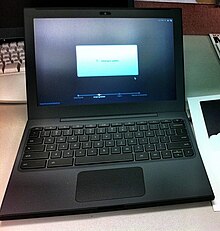
The Cr-48 showing the setup screen seen when first booting up a Chromebook
At a December 7, 2010 press briefing, Google announced the Cr-48 laptop, a reference hardware design to test the Chrome OS operating system. Chromium-48 is one of the most unstable isotopes of the metallic element chromium. The laptop's design broke convention by replacing the Caps lock key with a dedicated search key.
The Cr-48 was intended for testing only, not retail sales. Google addressed complaints that the operating system offers little functionality when the host device is not connected to the Internet. The company demonstrated an offline version of Google Docs running on Chrome OS and announced a 3G plan that would give Chrome OS users 100 MB of free data each month, with additional paid plans available from Verizon.
About 60,000 Cr-48s were distributed to testers and reviewers in early December 2010. Reviews of Chrome OS running on the Cr-48 in mid-December 2010 indicated that while the project held promise, it still had some distance to go before being ready for market.
On March 8, 2011, Google Product Management vice president Sundar Pichai stated that the last of the 60,000 Cr-48s had been shipped. The Cr-48 notebooks have additional unused hardware components for implementation at a future date, including a Bluetooth 2.1 controller. The USB port only acts as a keyboard, mouse, ethernet adapter, or USB storage port and will not work as a printer port as there is no print stack on the operating system. Adding further hardware outside of the previously mentioned items will likely cause problems with the operating system's "self knowing" security model. Users are encouraged to use a secure service called Google Cloud Print to print to legacy printers connected to their desktop computers, or connect an HP ePrint printer to the Google Cloud Print service for a "cloud aware" printer connection.

#from http://en.wikipedia.org

Samsung Galaxy

|

Samsung Galaxy may refer to any of several mobile computing devices produced by Samsung Electronics, all of which use the Android operating system.


Motorola Droid

|


Motorola-milestone-wikipedia.jpgThe Motorola Droid (stylized as DROID; GSM/UMTS version: Motorola Milestone) is an Internet and multimedia enabled smartphone designed by Motorola, which runs Google's Android operating system. The Droid had been publicized under the codenames Sholes and Tao and the model number A855. In Latin America and Europe, the model number is A853 (Milestone), and in Mexico, the model number is A854 (Motoroi). Due to the ambiguity with newer phones with similar names, it is also commonly known as the DROID 1 or the OG DROID (where OG is short for OriGinal or Original Gangster or Old school Gangster). The brand name Droid is a trademark of Lucasfilm licensed to Verizon Wireless.
Features of the phone include Wi-Fi networking, a 5-megapixel low light capable digital camera, a standard 3.5 mm headphone jack, interchangeable battery, 3.7-inch 854 x 480 touchscreen display. It also includes microSDHC support with bundled 16 GB card, free turn-by-turn navigation from Google Maps, sliding QWERTY keyboard, and Texas Instruments OMAP 3430 processor. The Motorola Droid runs Android version 2.2.
The phone does not, however, run the re-branded Motoblur interface for Android, instead providing the Google Experience skin and application stack.
The Droid has a hearing aid compatibility (hac) rating of M3/T3. The phone was the first to ship with free Google Maps Navigation (beta) installed.

#from http://en.wikipedia.org

Google Chrome OS

|


Google Chrome OS is a Linux-based operating system designed by Google to work exclusively with web applications. Google announced the operating system on July 7, 2009 and made it an open source project, called Chromium OS, that November.
Unlike Chromium OS, which can be compiled from the downloaded source code, Chrome OS only ships on specific hardware from Google's manufacturing partners. The user interface takes a minimalist approach, resembling that of the Chrome web browser. Since Google Chrome OS is aimed at users who spend most of their computer time on the Internet, the only application on the device is a browser incorporating a media player and a file manager.
The expected launch date for retail hardware featuring Chrome OS slipped after Google first announced the operating system: from an initial forecast date in late 2010 to June 15, 2011, when "Chromebooks" from Samsung (and then Acer in July) actually shipped.


#from http://en.wikipedia.org

Operating system

|

An operating system (OS) is a set of programs that manage computer hardware resources and provide common services for application software. The operating system is the most important type of system software in a computer system. A user cannot run an application program on the computer without an operating system, unless the application program is self booting.
Time-sharing operating systems schedule tasks for efficient use of the system and may also include accounting for cost allocation of processor time, mass storage, printing, and other resources.
For hardware functions such as input and output and memory allocation, the operating system acts as an intermediary between application programs and the computer hardware, although the application code is usually executed directly by the hardware and will frequently call the OS or be interrupted by it. Operating systems are found on almost any device that contains a computer—from cellular phones and video game consoles to supercomputers and web servers.

#from http://en.wikipedia.or

Android (operating system)

|


Android robot.svgAndroid is an operating system for mobile devices such as smartphones and tablet computers. It is developed by the Open Handset Alliance led by Google.
Google purchased the initial developer of the software, Android Inc., in 2005. The unveiling of the Android distribution on November 5, 2007 was announced with the founding of the Open Handset Alliance, a consortium of 84 hardware, software, and telecommunication companies devoted to advancing open standards for mobile devices. Google released most of the Android code under the Apache License, a free software license. The Android Open Source Project (AOSP) is tasked with the maintenance and further development of Android.
Android consists of a kernel based on the Linux kernel, with middleware, libraries and APIs written in C and application software running on an application framework which includes Java-compatible libraries based on Apache Harmony. Android uses the Dalvik virtual machine with just-in-time compilation to run Dalvik dex-code (Dalvik Executable), which is usually translated from Java bytecode.
Android has a large community of developers writing applications ("apps") that extend the functionality of the devices. Developers write primarily in a customized version of Java. There are currently approximately 300,000 apps available for Android, from a total of 500,000 apps over the life of Android. Apps can be downloaded from third-party sites or through online stores such as Android Market, the app store run by Google.
Android was listed as the best-selling smartphone platform worldwide in Q4 2010 by Canalys with over 200 million Android devices in use by November 2011.

#from http://en.wikipedia.or


Powered by Blogger.

Popular Posts

Search This Blog