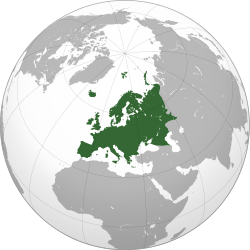
Europe is the world's second-smallest
continent by surface area, covering about 10,180,000 square kilometres
(3,930,000 sq mi) or 2% of the Earth's surface and about 6.8% of its
land area. Of Europe's approximately 50 states, Russia is the largest by both area and population (although the country has territory in both Europe and Asia), while the Vatican City is the smallest. Europe is the third-most populous continent after Asia and Africa, with a population of 733 million or about 11% of the world's population.
Europe, in particular Ancient Greece, is the birthplace of Western culture. It played a predominant role in global affairs from the 16th century onwards, especially after the beginning of colonialism. Between the 16th and 20th centuries, European nations controlled at various times the Americas, most of Africa, Oceania, and large portions of Asia. Both World Wars were largely focused upon Europe, greatly contributing to a decline in Western European dominance in world affairs by the mid-20th century as the United States and Soviet Union took prominence. During the Cold War, Europe was divided along the Iron Curtain between NATO in the west and the Warsaw Pact in the east. European integration led to the formation of the Council of Europe and the European Union in Western Europe, both of which have been expanding eastward since the fall of the Soviet Union in 1991.
#http://en.wikipedia.org
Popular Posts
-
A megapixel (MP or Mpx) is one million pixels, and is a term used not only for the number of pixels in an image, but to express the numb...
-
A touchscreen is an electronic visual display that can detect the presence and location of a touch within the display area. The term g...
-
In filmmaking and video production, footage is the raw, unedited material as it had been originally filmed by movie camera or recorded by a...
-
GSM ( Global System for Mobile Communications , originally Groupe Spécial Mobile ), is a standard set developed by the European Telecommun...
-
A smartphone is a high-end mobile phone built on a mobile computing platform, with more advanced computing ability and connectivity than a...
-
Lucasfilm Limited is an American film production company founded by George Lucas in 1971, based in San Francisco, California. Lucas is the...
-
In the fields of information science, communication, and industrial design, there is debate over the meaning of interactivity . In the ...
-
QWERTY is the most common modern-day keyboard layout. The name comes from the first six letters (keys) appearing in the topleft letter r...
-
Europe ( pronunciation: / ˈ jʊər ə p / yewr -əp or / ˈ j ɜr ə p / yur -əp ) is, by convention, one of the world's seven continents...


0 comments:
Post a Comment