- GPS-based services
- WLAN-, WiFi-based services
- Cell transmitter-based services
Google Maps Navigation
Motorola Droid | Wednesday, December 14, 2011
hearing aid compatibility
Motoblur
OMAP
QWERTY
sliding
#http://en.wikipedia.org
Google Maps
turn-by-turn navigation
microSDHC
- A newer card may offer greater capacity than the host device can handle
- A newer card may use a file system the host device cannot navigate
- Use of an SDIO card requires the host device be designed for the input/output functions the card provides
- The organization of the card was changed starting with the SDHC family
- Some vendors produced SDSC cards above 1 GB before the SDA had standardized a method of doing so.
touchscreen
The touchscreen has two main attributes. First, it enables one to interact directly with what is displayed, rather than indirectly with a pointer controlled by a mouse or touchpad. Secondly, it lets one do so without requiring any intermediate device that would need to be held in the hand. Such displays can be attached to computers, or to networks as terminals. They also play a prominent role in the design of digital appliances such as the personal digital assistant (PDA), satellite navigation devices, mobile phones, and video games.
#http://en.wikipedia.org
digital camera
megapixel
Wi-Fi
Verizon Wireless
Motorola Droid | Monday, December 12, 2011
Cellco Partnership Inc., doing business as Verizon Wireless, is one of the largest mobile network operators in the United States. The network has 107.7 million subscribers as of 2011, making it the largest wireless service provider in America.
Headquartered in Basking Ridge, New Jersey, the company is a joint venture of U.S. telecommunications firm Verizon Communications and UK multinational mobile network operator Vodafone, with 55 and 45 percent ownership respectively. On January 9, 2009, Verizon Wireless acquired Alltel Wireless in a deal valued at $28.1 billion. The acquisition expanded Verizon's wireless network.
#http://en.wikipedia.org
Lucasfilm
Lucasfilm Limited is an American film production company founded by George Lucas in 1971, based in San Francisco, California. Lucas is the company's current chairman and CEO, and Micheline Chau is the president and COO.
The company is best known for producing the Star Wars films, and has also produced other box office hits, including the Indiana Jones franchise and American Graffiti. It has also been a leader in developing new film technology in special effects, sound, and computer animation,
and because of their expertise its subsidiaries often help produce
non-Lucasfilm pictures. Lucasfilm is set to move away from films and
more into TV, due to rising budgets.
On July 8, 2005, Lucasfilm's marketing, online, and licensing units moved into the new Letterman Digital Arts Center located in the Presidio in San Francisco. It shares the complex with Industrial Light & Magic and LucasArts. They are also best known for The Deep Note and THX.
Lucasfilm has collaborated with the Walt Disney Company and Walt Disney Imagineering numerous times to create rides and attractions centered on Star Wars and Indiana Jones for various Walt Disney Parks and Resort attractions worldwide.
#http://en.wikipedia.org
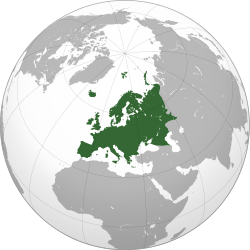
Europe
Europe (pronunciation: /ˈjʊərəp/ yewr-əp or /ˈjɜrəp/ yur-əp) is, by convention, one of the world's seven continents. Comprising the westernmost peninsula of Eurasia, Europe is generally 'divided' from Asia to its east by the watershed divides of the Ural and Caucasus Mountains, the Ural River, the Caspian and Black Seas, and the waterways connecting the Black and Aegean Seas. Europe is bordered by the Arctic Ocean and other bodies of water to the north, the Atlantic Ocean to the west, the Mediterranean Sea to the south, and the Black Sea and connected waterways to the southeast. Yet the borders of Europe—a concept dating back to classical antiquity—are somewhat arbitrary, as the primarily physiographic term "continent" can incorporate cultural and political elements.
Europe is the world's second-smallest
continent by surface area, covering about 10,180,000 square kilometres
(3,930,000 sq mi) or 2% of the Earth's surface and about 6.8% of its
land area. Of Europe's approximately 50 states, Russia is the largest by both area and population (although the country has territory in both Europe and Asia), while the Vatican City is the smallest. Europe is the third-most populous continent after Asia and Africa, with a population of 733 million or about 11% of the world's population.
Europe, in particular Ancient Greece, is the birthplace of Western culture. It played a predominant role in global affairs from the 16th century onwards, especially after the beginning of colonialism. Between the 16th and 20th centuries, European nations controlled at various times the Americas, most of Africa, Oceania, and large portions of Asia. Both World Wars were largely focused upon Europe, greatly contributing to a decline in Western European dominance in world affairs by the mid-20th century as the United States and Soviet Union took prominence. During the Cold War, Europe was divided along the Iron Curtain between NATO in the west and the Warsaw Pact in the east. European integration led to the formation of the Council of Europe and the European Union in Western Europe, both of which have been expanding eastward since the fall of the Soviet Union in 1991.
#http://en.wikipedia.org
Latin America
Latin America (Spanish: América Latina or Latinoamérica; Portuguese: América Latina; French: Amérique latine) is a region of the Americas where Romance languages (i.e., those derived from Latin) – particularly Spanish and Portuguese, and variably French – are primarily spoken. Latin America has an area of approximately 21,069,500 km² (7,880,000 sq
mi), almost 3.9% of the Earth's surface or 14.1% of its land surface
area. As of 2010, its population was estimated at more than 590 million and its combined GDP at 5.16 trillion United States dollars (6.27 trillion at PPP). The Latin American expected economic growth rate
is at about 5.7% for 2010 and 4% in 2011.
#http://en.wikipedia.org
smartphone
A smartphone is a high-end mobile phone built on a mobile computing platform, with more advanced computing ability and connectivity than a contemporary feature phone. The first smartphones were devices that mainly combined the functions of a personal digital assistant (PDA) and a mobile phone or camera phone. Today's models also serve to combine the functions of portable media players, low-end compact digital cameras, pocket video cameras, and GPS navigation units. Modern smartphones typically also include high-resolution touchscreens, web browsers
that can access and properly display standard web pages rather than
just mobile-optimized sites, and high-speed data access via Wi-Fi and mobile broadband.
The most common mobile operating systems (OS) used by modern smartphones include Google's Android, Apple's iOS, Microsoft's Windows Phone, Nokia's Symbian, RIM's BlackBerry OS, and embedded Linux distributions such as Maemo and MeeGo.
Such operating systems can be installed on many different phone models,
and typically each device can receive multiple OS software updates over
its lifetime.
The distinction between smartphones and feature phones can be vague
and there is no official definition for what constitutes the difference
between them. One of the most significant differences is that the
advanced application programming interfaces (APIs) on smartphones for running third-party applications
can allow those applications to have better integration with the
phone's OS and hardware than is typical with feature phones. In
comparison, feature phones more commonly run on proprietary firmware, with third-party software support through platforms such as Java ME or BREW.
An additional complication in distinguishing between smartphones and
feature phones is that over time the capabilities of new models of
feature phones can increase to exceed those of phones that had been
promoted as smartphones in the past.
#http://en.wikipedia.org
multimedia
|
|
|
|
|
|
|
|
#http://en.wikipedia.org
Interactivity
In the fields of information science, communication, and industrial design, there is debate over the meaning of interactivity. In the "contingency view" of interactivity, there are three levels:
- Noninteractive, when a message is not related to previous messages;
- Reactive, when a message is related only to one immediately previous message; and
- Interactive, when a message is related to a number of previous messages and to the relationship between them.
#http://en.wikipedia.org
Footage
In filmmaking and video production, footage is the raw, unedited material as it had been originally filmed by movie camera or recorded by a video camera which usually must be edited to create a motion picture, video clip, television show or similar completed work. More loosely, footage can also refer to all sequences used in film and video editing, such as special effects and archive material (for special cases of this, see stock footage and B roll). Since the term originates in film, footage is only used for recorded images, such as film stock, videotapes or digitized clips – on live television, the signals from video cameras are called sources instead.
The origin of the term "footage" is that early 35 mm silent film has traditionally been measured in feet and frames; the fact that film was measured by length in cutting rooms, and that there are 16 frames (4-perf
film format) in a foot of 35 mm film which roughly represented 1 second
of silent film, made footage a natural unit of measure for film. The
term then became used figuratively to describe moving image material of
any kind.
Television footage, especially news footage, is often traded between television networks,
but good footage usually commands a high price. The actual sum depends
on duration, age, size of intended audience, duration of licensing and
other factors. Amateur movie footage of current events can also often fetch a high price on the market – scenes shot inside the World Trade Center during the September 11, 2001 attacks were reportedly sold for US$45,000. Sometimes film projects will also sell or trade footage, usually second unit material not used in the final cut. For example, the end of the non-director's cut version of Blade Runner used landscape views that were originally shot for The Shining before the script was modified after shooting had finished.
#http://en.wikipedia.org
Animation
Animation is the rapid display of a sequence of images of 2-D or 3-D artwork or model positions in order to create an illusion of movement. The effect is an optical illusion of motion due to the phenomenon of persistence of vision,
and can be created and demonstrated in several ways. The most common
method of presenting animation is as a motion picture or video program,
although there are other methods.
#http://en.wikipedia.org
Image
Images may be two-dimensional, such as a photograph, screen display, and as well as a three-dimensional, such as a statue or hologram. They may be captured by optical devices—such as cameras, mirrors, lenses, telescopes, microscopes, etc. and natural objects and phenomena, such as the human eye or water surfaces.
The word image is also used in the broader sense of any two-dimensional figure such as a map, a graph, a pie chart, or an abstract painting. In this wider sense, images can also be rendered manually, such as by drawing, painting, carving, rendered automatically by printing or computer graphics technology, or developed by a combination of methods, especially in a pseudo-photograph.
A volatile image is one that exists only for a short period of time.
This may be a reflection of an object by a mirror, a projection of a camera obscura, or a scene displayed on a cathode ray tube. A fixed image, also called a hard copy, is one that has been recorded on a material object, such as paper or textile by photography or digital processes.
A mental image
exists in an individual's mind: something one remembers or imagines.
The subject of an image need not be real; it may be an abstract concept,
such as a graph, function, or "imaginary" entity. For example, Sigmund Freud
claimed to have dreamed purely in aural-images of dialogs. The
development of synthetic acoustic technologies and the creation of sound art
have led to a consideration of the possibilities of a sound-image made
up of irreducible phonic substance beyond linguistic or musicological
analysis.
A still image is a single static image, as distinguished from a kinetic image (see below). This phrase is used in photography, visual media and the computer industry to emphasize that one is not talking about movies, or in very precise or pedantic technical writing such as a standard.
A film still is a photograph taken on the set of a movie or television program during production, used for promotional purposes.
There are many sayings about images. Such as "A picture is worth a thousand words.", as we know is not literally true.
#http://en.wikipedia.org
Sound recording and reproduction
Sound recording and reproduction is an electrical or mechanical inscription and re-creation of sound waves, such as spoken voice, singing, instrumental music, or sound effects. The two main classes of sound recording technology are analog recording and digital recording. Acoustic analog recording is achieved by a small microphone diaphragm that can detect changes in atmospheric pressure (acoustic sound waves) and record them as a graphic representation of the sound waves on a medium such as a phonograph (in which a stylus senses grooves on a record). In magnetic tape recording, the sound waves vibrate the microphone diaphragm and are converted into a varying electric current, which is then converted to a varying magnetic field by an electromagnet,
which makes a representation of the sound as magnetized areas on a
plastic tape with a magnetic coating on it. Analog sound reproduction is
the reverse process, with a bigger loudspeaker
diaphragm causing changes to atmospheric pressure to form acoustic
sound waves. Electronically generated sound waves may also be recorded
directly from devices such as an electric guitar pickup or a synthesizer,
without the use of acoustics in the recording process other than the
need for musicians to hear how well they are playing during recording sessions.
Digital recording and reproduction converts the analog sound signal
picked up by the microphone to a digital form by a process of digitization, allowing it to be stored and transmitted by a wider variety of media. Digital recording stores audio as a series of binary numbers representing samples of the amplitude of the audio signal at equal time intervals, at a sample rate high enough to convey all sounds capable of being heard. Digital recordings are considered higher quality than analog recordings not necessarily because they have higher fidelity (wider frequency response or dynamic range), but because the digital format can prevent much loss of quality found in analog recording due to noise and electromagnetic interference in playback, and mechanical deterioration or damage to the storage medium. A digital audio signal must be reconverted to analog form during playback before it is applied to a loudspeaker or earphones.
#http://en.wikipedia.org
Writing
Writing is the representation of language in a textual medium through the use of a set of signs or symbols (known as a writing system). It is distinguished from illustration, such as cave drawing and painting, and non-symbolic preservation of language via non-textual media, such as magnetic tape audio.
Writing most likely began as a consequence of political expansion in
ancient cultures, which needed reliable means for transmitting
information, maintaining financial accounts, keeping historical records,
and similar activities. Around the 4th millennium BC, the complexity of
trade and administration outgrew the power of memory, and writing became a more dependable method of recording and presenting transactions in a permanent form. In both Ancient Egypt and Mesoamerica writing may have evolved through calendrics and a political necessity for recording historical and environmental events.
#http://en.wikipedia.org
Internet
Motorola Droid | Friday, December 9, 2011
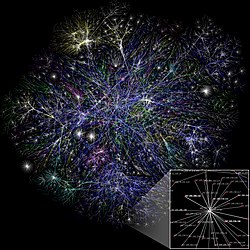
The Internet is a global system of interconnected computer networks that use the standard Internet protocol suite (TCP/IP) to serve billions of users worldwide. It is a network of networks
that consists of millions of private, public, academic, business, and
government networks, of local to global scope, that are linked by a
broad array of electronic, wireless and optical networking technologies.
The Internet carries a vast range of information resources and services, such as the inter-linked hypertext documents of the World Wide Web (WWW) and the infrastructure to support email.
Most traditional communications media including telephone, music, film, and television are reshaped or redefined by the Internet, giving birth to new services such as Voice over Internet Protocol (VoIP) and IPTV. Newspaper, book and other print publishing are adapting to Web site technology, or are reshaped into blogging and web feeds. The Internet has enabled or accelerated new forms of human interactions through instant messaging, Internet forums, and social networking. Online shopping has boomed both for major retail outlets and small artisans and traders. Business-to-business and financial services on the Internet affect supply chains across entire industries.
The origins of the Internet reach back to research of the 1960s, commissioned by the United States government
in collaboration with private commercial interests to build robust,
fault-tolerant, and distributed computer networks. The funding of a new
U.S. backbone by the National Science Foundation
in the 1980s, as well as private funding for other commercial
backbones, led to worldwide participation in the development of new
networking technologies, and the merger of many networks. The commercialization
of what was by the 1990s an international network resulted in its
popularization and incorporation into virtually every aspect of modern
human life. As of 2011, more than 2.1 billion people – nearly a third of
Earth's population – use the services of the Internet.
The Internet has no centralized governance in either technological
implementation or policies for access and usage; each constituent
network sets its own standards. Only the overreaching definitions of the
two principal name spaces in the Internet, the Internet Protocol address space and the Domain Name System, are directed by a maintainer organization, the Internet Corporation for Assigned Names and Numbers (ICANN). The technical underpinning and standardization of the core protocols (IPv4 and IPv6) is an activity of the Internet Engineering Task Force
(IETF), a non-profit organization of loosely affiliated international
participants that anyone may associate with by contributing technical
expertise.
#http://en.wikipedia.org
UMTS
Universal Mobile Telecommunications System (UMTS) is a third generation mobile cellular technology for networks based on the GSM standard. Developed by the 3GPP (3rd Generation Partnership Project), UMTS is a component of the International Telecommunications Union IMT-2000 standard set and compares with the CDMA2000 standard set for networks based on the competing cdmaOne
technology. UMTS employs wideband code division multiple access
(W-CDMA) radio access technology to offer greater spectral efficiency
and bandwidth to mobile network operators. UMTS specifies a complete
network system, covering the radio access network (UMTS Terrestrial Radio Access Network, or UTRAN), the core network (Mobile Application Part, or MAP) and the authentication of users via SIM cards (Subscriber Identity Module).
The technology described in UMTS is sometimes also referred to as Freedom of Mobile Multimedia Access (FOMA) or 3GSM.
Unlike EDGE (IMT Single-Carrier, based on GSM) and CDMA2000 (IMT Multi-Carrier), UMTS requires new base stations and new frequency allocations.
#http://en.wikipedia.org
GSM
GSM (Global System for Mobile Communications, originally Groupe Spécial Mobile), is a standard set developed by the European Telecommunications Standards Institute (ETSI) to describe technologies for second generation (or "2G") digital cellular networks.
Developed as a replacement for first generation analog cellular
networks, the GSM standard originally described a digital, circuit
switched network optimized for full duplex voice telephony. The standard was expanded over time to include first circuit switched data transport, then packet data transport via GPRS. Packet data transmission speeds were later increased via EDGE. The GSM standard is succeeded by the third generation (or "3G") UMTS standard developed by the 3GPP. GSM networks will evolve further as they begin to incorporate fourth generation (or "4G") LTE Advanced standards. "GSM" is a trademark owned by the GSM Association.
The GSM Association estimates that technologies defined in the GSM
standard serve 80% of the world's population, encompassing more than 5
billion people across more than 212 countries and territories, making
GSM the most ubiquitous of the many standards for cellular networks.
#http://en.wikipedia.org
Samsung Galaxy Y
Samsung Galaxy | Wednesday, November 30, 2011
Galaxy Nexus
The Galaxy Nexus is a touchscreen slate Android smartphone developed by a partnership between Samsung and Google. The phone and operating system were developed collaboratively by engineers from both companies. It is the third generation successor to Google’s previous flagship phones, the Nexus One and Nexus S. It has a curved HD (1280×720 pixels) Super AMOLED display, an improved camera system, and Google’s new version of its Android operating system, version 4.0, codenamed Ice Cream Sandwich. The name is the result of co-branding between the Samsung Galaxy and Google Nexus brands of Android smartphones.
The Galaxy Nexus was unveiled at Google and Samsung's Ice Cream Sandwich event on 19 October, 2011 in Hong Kong. It was released on November 17, 2011.
Hardware:
The Galaxy Nexus features a 4.65-inch 1280×720-pixel HD Super AMOLED PenTile curved glass display a dual-core 1.2 GHz TI OMAP 4460 processor (ARM Cortex-A9) with an accompanying PowerVR SGX540, GB of RAM. The processor can run from 1.2–1.5 GHz, but is
underclocked at 1.2 GHz for smooth performance. However, it can easily
run at 1.5 GHz once rooted (see Texas Instruments OMAP). Additionally, a 1,750 mAh battery, 1.3 MP front camera and 5 MP rear camera (with zero shutter lag) capable of 1080p video, 4G, Wi-Fi a/b/g/n, Bluetooth, GPS, barometer, and NFC and it has 16 or 32 GB of internal memory.
The Galaxy Nexus also hosts support for MHL through the use of its Micro USB 2.0 port. This means that the Galaxy Nexus has the ability to output up to 1080p audio-visual content (through HDMI) to any supported external display such as HD Television
The Galaxy Nexus has no physical buttons on the front, but instead features on-screen soft keys embedded into the system software (part of Android 4.0). Beneath the soft keys, a multicolored notification LED is featured, a feature missing from the Nexus S.
The 3.5 mm headphone jack
is located on the bottom of the phone, and the camera is located in the
center of the rear side. The phone will have 16/32 GB internal storage
depending on model.
#from http://en.wikipedia.org
Samsung Stratosphere
The 4-inch, 800-by-480-pixel Super AMOLED display is gorgeous. It can
get incredibly bright, but darker colors manage to maintain their depth
and richness. Four haptic feedback-enabled functions keys sit beneath
the display, which are suitably responsive. I had some difficulty typing
on the onscreen QWERTY keyboard with accuracy. Thankfully, the
Stratosphere slides open to reveal a large, five-row physical keyboard.
The keys are slightly raised, and while the spacing took some getting
used to, frequent messagers should be pleased.
The Stratosphere is a dual-band EV-DO Rev A (850/1900MHz) and 750MHz
4G LTE device with 802.11a/b/g/n Wi-Fi. Verizon says to expect download
speeds around 5 to 12Mbps, and upload speeds between 2 and 5Mbps on its
4G network. The Stratosphere hit those speeds without a hitch, pulling
in numbers equal to the Motorola Droid Bionic ($299.99,
4.5 stars) in a series of head-to-head tests; both phones averaged
around 5Mbps down and 3.5Mbps up. You can also use the Stratosphere as a
mobile hotspot with the appropriate plan to provide a Wi-Fi connection
for up to eight devices.
Voice quality is very good. Reception is average, and incoming calls
sound rich and clear, with volume that can go very loud. On the other
end, calls made with the phone are equally clear and feature excellent
background noise cancellation. The speakerphone sounds good, though it's
a little low for outdoor use. Calls sounded clear and natural through
a Jawbone Era Bluetooth headset ($129, 4.5 stars) and voice dialing worked accurately.
Battery life is still not a strong point for 4G LTE devices.
Streaming content over 4G, the Stratosphere lasted for just 2 hours and
47 minutes. That's not great, but it's about average for now. Talk time
was better, at 6 hours and 14 minutes.
Samsung Exhibit 4G
In it you will find a 1GHz processor, 3-megapixel camera with flash, front-facing VGA shooter for self-portraits and video chat, mobile Wi-Fi, full HTML browser with Flash, memory card slot, USB tethering, and support for + T-Mobile's HSPA network. If you are bored, you can watch live TV and on-demand service from T-Mobile TV, download movies and TV programs from the Samsung Media Hub. There are also a variety of games that are already installed such as Bejeweled 2, Scrabble and Doodle Jump.
Samsung Galaxy W
Network: GSM Quadband and HSDPA / HSUPA Dualband Processor: 1.4GHz singlecore OS: Android v2.3 Gingerbread Screen: Capacitive Touchscreen TFT MultiTouch + width 3.7inc Camera: 5MP Autofous FlshLED + + Record HD Video Connectivity: Bluetooth v3.0, WiFi 802.11 b / g / n, 14.4Mbps HSDPA + HSUPA 5.76 Mbps, MicroUSB v2.0, A-GPS Memory: MicroSD up to 32GB, 4GB Internal Battery: Li-Ion 1500mAh Size: 115.5 x 60 x 11.5 mm Weight: 112 grams Colours : Black (Black)...
Samsung Galaxy S II
he Samsung Galaxy S II (GT-I9100) is a smartphone running under the Android operating system that was announced by Samsung on February 13, 2011 at the Mobile World Congress. It is the successor to the Samsung Galaxy S, with a different appearance and significantly improved hardware.
The Galaxy S II was one of the slimmest smartphones of the time, mostly
8.49 mm thick, except for two small bulges which take the total
thickness of the phone to 9.91 mm.
The Galaxy S II has a 1.2 GHz dual-core "Exynos" system on a chip (SoC) processor, 1 GB of RAM, a 10.8 cm (4.3 in) WVGA Super AMOLED Plus screen display and an 8 megapixel camera with flash and full 1080p high definition video recording. It is one of the first devices to offer a Mobile High-definition Link (MHL), which allows up to 1080p uncompressed video output with HDMI while charging the device at the same time. USB On-The-Go (USB OTG) is supported.
The user-replaceable battery on the Galaxy S II gives up to ten hours of heavy usage, or two days of lighter usage. Samsung claims that talk time is 9 hours on 3G and 18.3 hours on 2G.
#from http://en.wikipedia.org
Samsung Galaxy S
The Samsung Galaxy S is an Android smartphone that was announced by Samsung in March 2010. It features a 1 GHz ARM "Hummingbird" processor, 8–16 GB internal Flash memory, a 4-inch 480×800 pixel Super AMOLED capacitive touchscreen display, Wi-Fi connectivity, a 5-megapixel camera with a maximum resolution of 2560x1920 and, on select models, a front-facing 0.3 MP VGA camera (640x480).
The base version of the phone, the GT-I9000, was quickly followed by
variant models for the US carriers such as the Epic 4G, Vibrant,
Captivate, Fascinate, and Mesmerize.
The Samsung Galaxy S features a PowerVR graphics processor, yielding 20 million triangles per second, making it the fastest graphics processing unit in any smartphone at the time of release. Also, upon release, the Galaxy S was both the first Android phone to be certified for DivX HD, and at 9.9 mm was the thinnest smartphone available.
As of January 2011, Samsung had sold 10 million Galaxy S phones globally. The Galaxy S was named the European Smartphone of the Year at the European Imaging and Sound Association (EISA) Awards 2010–2011. Samsung Galaxy S was succeeded by Samsung Galaxy S II. In October 2011, Samsung announced that it had sold 30 Million Galaxy S and Galaxy S II phones globally.
#from http://en.wikipedia.org
Samsung Galaxy R
Samsung Galaxy Prevail
The Samsung Galaxy Prevail is an entry level device for Boost
Mobile. Unlike some of it's Galaxy S cousins, you wont find some of the
higher end "Galaxy S" features and it doesn't have the familiar
TouchWhiz interface seen on so many other Samsung devices.
The Prevail comes with an 800MHz single-core processor, 3.2-inch 320x480
capacitive display, a 2 megapixel rear camera, Wi-Fi, Bluetooth, GPS,
and launched with Android 2.2 Froyo. Great value for the money.
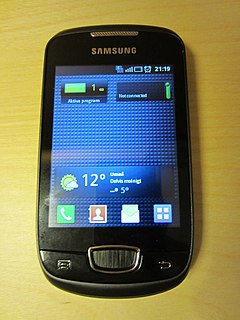
Samsung Galaxy Mini
The Samsung Galaxy Mini, is a smartphone manufactured by Samsung that runs the open source Android operating system. Announced and released by Samsung in spring of 2011. On the Indian market it is known as Samsung Galaxy Pop and on some other markets it is known as Samsung Galaxy Next. It is currently available in four different colors; steel grey, white, lime and orange.
Features:
The Galaxy Mini is a 3.5G smartphone that offers quad-band GSM and announced with two-band HSDPA (900/2100 MHz) at 7.2 Mbit/s. The display is a 3.14-inch (80 mm) TFT LCD capacitive touchscreen of vertical QVGA
(240x320) resolution. There is also a 3-megapixel camera, capable of
recording videos at QVGA (320x240) resolution. The Galaxy Mini comes
with a 1.2 Ah Li-ion battery. The Galaxy Mini runs on Android 2.2 Froyo.
Galaxy Mini is presented as a entry-level smartphone, and is (as of 13 May 2011) one of the cheapest Android phones around.
In May 2011, Samsung announced
that the Galaxy Mini (along with other Galaxy models) will get an
official upgrade to Android 2.3. As of November 2011 the rollout is
still in progress. If voiding the warranty is not a concern then a
leaked upgrade can be applied already.
#from http://en.wikipedia.org
Samsung Galaxy Gio
The Samsung Galaxy Gio is a smartphone manufactured by Samsung operating the Android operating system.
It was announced at the 2011 Mobile World Congress as one of four Samsung low-end smartphones, along with the Galaxy Ace, Galaxy Fit and Galaxy mini.
In early August 2011, Samsung officially rolled out the Gingerbread update via Kies. In September 2011, Samsung rolled out an update in The Netherlands marked "PDA:KPS PHONE:KPA CSC:KP1 (XEN)"
Features:
The device is equipped with a 3.2 inches (8.1 cm) HVGA screen, a three-megapixel camera and an 800 megahertz processor. It runs on Android 2.2, with Samsung's TouchWiz user interface.
#from http://en.wikipedia.org
Samsung Galaxy Fit
The Samsung Galaxy Fit S5670 is a smartphone manufactured by Samsung that runs the open source Android operating system.
It was announced at the 2011 Mobile World Congress as one of four Samsung low-end smartphones, along with the Galaxy Ace, Galaxy Gio and Galaxy mini
Features:
The device's is equipped with a 3.3 inches (8.4 cm) QVGA screen, a 5-megapixel camera and a 600 megahertz processor. The Fit runs on Android 2.2 Froyo and a modified version of TouchWiz, Samsung's proprietary user interface. The Galaxy Fit also has a Swype option which allows you to draw lines from letter to letter in order to type.
#from http://en.wikipedia.org
Samsung Galaxy Skin
Based on the International Business Times, or IBT, smart phone device manufacturers from South Korea will launch Galaxy Skin in the second quarter of 2012. According to news circulating today, the Samsung Galaxy Skin that will come with a 1.2GHz processor will be equipped with a specification of flexible AMOLED screen is 4 inches with a resolution of 800 × 480, 8MP camera that comes with auto focus, self shot, action shot, Panorama shot, stop motion, smile shot and Add Me feature, and a VGA front camera.Besides Samsung Galaxy Skin will also be supported by 1GB of RAM, 1500 mAh Battery, Network 3.5G (GSM / GPRS / EDGE): 850/900/1800/1900 MHz), 4G (HSDPA 7.2 Mbps, HSUPA 5.76 Mbps): 900 / 1900/2100 MHz. Like the smart phones in general, the Samsung Galaxy Skin will also feature a variety of advanced features. In this case, the Samsung Galaxy Skin will be equipped with a message using the Social Integration Hub, Android Market, A-GPS, the application of Augmented Realty: Realty Screen Browser, SMS, MMS, Email, Video messaging, Exchange ActiveSync.
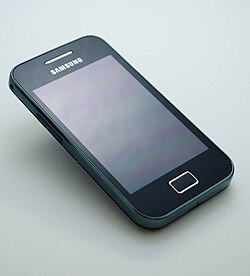
Samsung Galaxy Ace
The Samsung Galaxy Ace, is a smartphone manufactured by Samsung that runs the open source Android operating system. Announced and released by Samsung in February 2011, the Galaxy Ace is the successor to the Galaxy 3.
The Galaxy Ace is one of the four budget, low-cost Android-based smartphones planned by Samsung. Being an upper mid-range smartphone, the Ace has a hardware between that of the Galaxy 3 and the Galaxy S; it features an 800 MHz Qualcomm MSM7227 processor with the Adreno 200 GPU.
It is currently available in black with back covers in two different colors, black and white.
Features:
The Galaxy Ace is a 3.5G smartphone, offers quad-band GSM and
announced with two-band HSDPA (900/2100) at 7.2Mbps. The display is a
3.5 inch TFT LCD capacitive touchscreen of HVGA (320x480) resolution.
There is also a 5-megapixel camera with LED flash, capable of recording
videos at QVGA (320x240) resolution and VGA (640x480) resolution with
the Gingerbread update. The Ace comes with a 1350mAh Li-Ion battery.[7] The Ace runs Android 2.2 Froyo, Samsung's proprietary user interface and is also upgradable to Android 2.3.5 Gingerbread.
Ace has heavy social network integration abilities and multimedia
features. It also is preloaded with Google Trademark Mobile Apps.
#from http://en.wikipedia.org
Samsung Galaxy 551
#from http://en.wikipedia.org
Popular Posts
-
In filmmaking and video production, footage is the raw, unedited material as it had been originally filmed by movie camera or recorded by a...
-
A touchscreen is an electronic visual display that can detect the presence and location of a touch within the display area. The term g...
-
A megapixel (MP or Mpx) is one million pixels, and is a term used not only for the number of pixels in an image, but to express the numb...
-
A smartphone is a high-end mobile phone built on a mobile computing platform, with more advanced computing ability and connectivity than a...
-
Motoblur (often stylized as MOTOBLUR ) is an Android UI replacement and push-based service focused on social networking developed by Motor...
-
GSM ( Global System for Mobile Communications , originally Groupe Spécial Mobile ), is a standard set developed by the European Telecommun...
-
QWERTY is the most common modern-day keyboard layout. The name comes from the first six letters (keys) appearing in the topleft letter r...
-
Europe ( pronunciation: / ˈ jʊər ə p / yewr -əp or / ˈ j ɜr ə p / yur -əp ) is, by convention, one of the world's seven continents...
-
OMAP developed by Texas Instruments is a category of proprietary system on chips (SoCs) for portable and mobile multimedia applicatio...