
The service launched on June 28, 2011, in an invite-only "field testing" phase.The following day, existing users were allowed to invite friends who were over 18 years of age to the service to create their own accounts. This was suspended the next day due to an "insane demand" for accounts. On August 6, each Google+ member had 150 invites to give out, but on September 20, 2011, Google+ was opened to everyone 18 years of age or older without the need for an invitation. After Google+ went public, users registered to Google with an age under 18 were unable to sign up for Google+. Google plans to open up Google+ to all users over the ages of 13 after proper safety features are added.
Google+ integrates social services such as Google Profiles and Google Buzz, and introduces new services identified as Circles, Hangouts and Sparks. Google+ is available as a web site, and will be available as a desktop application, and is already available as a mobile application, but only on the Android and iOS operating systems. Google has launched an API platform for developers. ources such as The New York Times have declared it Google's biggest attempt to rival the social network Facebook, which had over 800 million users in 2011.
At the initial launch, Google Apps mail profiles could not be used on Google+ due to lack of support for Google Profiles.
On October 27, Google announced Google Apps support for Google+ users
when the service was manually enabled by the Google Apps domain
administrator.
Google+
Google | Monday, October 31, 2011
Google |

It was first incorporated as a privately held company on September 4, 1998, and its initial public offering
followed on August 19, 2004. At that time Larry Page, Sergey Brin, and
Eric Schmidt agreed to work together at Google for twenty years, until
the year 2024.
The company's mission statement from the outset was "to organize the
world's information and make it universally accessible and useful", and the company's unofficial slogan – coined by Google engineer Amit Patel and supported by Paul Buchheit – is "Don't be evil". In 2006, the company moved to its current headquarters in Mountain View, California.
Google's rapid growth since its incorporation has triggered a chain
of products, acquisitions, and partnerships beyond the company's core web search engine. The company offers online productivity software, such as its Gmail email service, and social networking tools, including Orkut and, more recently, Google Buzz and Google+. Google's products extend to the desktop as well, with applications such as the web browser Google Chrome, the Picasa photo organization and editing software, and the Google Talk instant messaging application. Google leads the development of the Android mobile operating system, used on a number of phones such as the Motorola Droid and the Samsung Galaxy smartphone series', as well as the new Google Chrome OS, best known as the main operating system on the Cr-48 and also, since 15 June 2011, on commercial Chromebooks such as the Samsung Series 5 and Acer AC700.
It has been estimated that Google runs over one million servers in data centers around the world, and processes over one billion search requests and about twenty-four petabytes of user-generated data every day.Alexa
lists the main U.S.-focused google.com site as the Internet's most
visited website, and numerous international Google sites
(google.co.in(14) is the most visited site in India, google.co.uk in the
U.K, etc.) are in the top hundred, as are several other Google-owned
sites such as YouTube (Alexa:3), Blogger (Alexa:6), and Orkut. Google also ranks number two in the BrandZ brand equity database. The dominant market position of Google's services has led to criticism of the company over issues including privacy, copyright, and censorship.
from en.wikipedia.org
Google Buzz
Google |

Buzz enables users to choose to share publicly with the world or privately to a group of friends each time they post. Picasa, Flickr, Google Latitude, Google Reader, Google Sidewiki, YouTube, Blogger, FriendFeed, identi.ca and Twitter
are currently integrated. The creation of Buzz was seen by industry
analysts as an attempt by Google to compete with social networking
websites like Facebook and microblogging services like Twitter.
Buzz also includes several interface and interaction elements from
other Google products (e.g. Google Reader) such as the ability to "like"
a post.
Google executive Sergey Brin said that by offering social communications, Buzz would help bridge the gap between work and leisure, but the service and its rollout were strongly criticized at the time for taking insufficient account of privacy concerns.
orkut
Google |

Originally hosted in California, in August 2008 Google announced that orkut would be fully managed and operated in Brazil, by Google Brazil, in the city of Belo Horizonte. This was decided due to the large Brazilian user base and growth of legal issues.
As of October 2011, Alexa traffic ranked orkut.com 126th and orkut.com.br 128th in the world; the website currently has over 66 million active users worldwide.
Over the years, orkut has also found great popularity in Estonia as witnessed by a survey conducted by the independent research center GfK Custom Research Baltic which showed how orkut is the most used social network platform in that country. Its popularity however faded in 2010, when most Estonians switched over to Facebook.
A social networking service
Google |

The main types of social networking services are those that contain
category places (such as former school year or classmates), means to
connect with friends (usually with self-description pages), and a
recommendation system linked to trust. Popular methods now combine many
of these, with Facebook and Twitter widely used worldwide, Nexopia (mostly in Canada); Bebo, VKontakte, Hi5, Hyves (mostly in The Netherlands), Draugiem.lv (mostly in Latvia), StudiVZ (mostly in Germany), iWiW (mostly in Hungary), Tuenti (mostly in Spain), Nasza-Klasa (mostly in Poland), Decayenne, Tagged, XING, Badoo and Skyrock in parts of Europe; Orkut and Hi5 in South America and Central America; and Mixi, Multiply, Orkut, Wretch, renren and Cyworld in Asia and the Pacific Islands and Facebook, Twitter, LinkedIn and Google+ are very popular in India.
There have been attempts to standardize these services to avoid the need to duplicate entries of friends and interests (see the FOAF standard and the Open Source Initiative). A 2011 survey found that 47% of American adults use a social network.
Gmail
Google |

With an initial storage capacity offer of 1 GB per user, Gmail significantly increased the webmail standard for free storage from the 2 to 4 MB its competitors such as Hotmail offered at that time. Individual Gmail messages, including attachments, may be up to 25 MB, which is larger than many other mail services support. Gmail has a search-oriented interface and a "conversation view" similar to an Internet forum. Gmail is noted by web developers for its pioneering use of AJAX. Gmail runs on Google GFE/2.0 on Linux. As of October 2011, it had 260 million users worldwide.
Mountain View
Google |

Situated in Silicon Valley, Mountain View is home to many high technology companies. In 1956, Shockley Semiconductor Laboratory, the first company to develop silicon semiconductor devices in what came to be known as Silicon Valley, was established in the city by William Shockley. Today, many of the largest technology companies in the world are headquartered in the city, including the Fortune 1000 companies Google, Symantec, and Intuit.
"Don't be evil"
Google |
 "Don't be evil" is the informal corporate motto (or slogan) of Google, originally suggested by Google employees Paul Buchheit and Amit Patel at a meeting. Buchheit, the creator of Gmail,
said he "wanted something that, once you put it in there, would be hard
to take out," adding that the slogan was "also a bit of a jab at a lot
of the other companies, especially our competitors, who at the time, in
our opinion, were kind of exploiting the users to some extent." While
the official corporate philosophy of Google does not contain the words "Don't be evil", they were included in the prospectus (aka "S-1") of Google's 2004 IPO
(a letter from Google's founders, later called the "'Don't Be Evil'
manifesto"): "Don’t be evil. We believe strongly that in the long term,
we will be better served — as shareholders and in all other ways — by a
company that does good things for the world even if we forgo some short
term gains." The sixth point of the 10-point corporate philosophy of Google says "You can make money without doing evil." The motto is often incorrectly stated as "Do no evil".
"Don't be evil" is the informal corporate motto (or slogan) of Google, originally suggested by Google employees Paul Buchheit and Amit Patel at a meeting. Buchheit, the creator of Gmail,
said he "wanted something that, once you put it in there, would be hard
to take out," adding that the slogan was "also a bit of a jab at a lot
of the other companies, especially our competitors, who at the time, in
our opinion, were kind of exploiting the users to some extent." While
the official corporate philosophy of Google does not contain the words "Don't be evil", they were included in the prospectus (aka "S-1") of Google's 2004 IPO
(a letter from Google's founders, later called the "'Don't Be Evil'
manifesto"): "Don’t be evil. We believe strongly that in the long term,
we will be better served — as shareholders and in all other ways — by a
company that does good things for the world even if we forgo some short
term gains." The sixth point of the 10-point corporate philosophy of Google says "You can make money without doing evil." The motto is often incorrectly stated as "Do no evil".
"Don't be evil" is said to recognize that large corporations often
maximize short-term profits with actions that may not be in the best
interests of the public. Supposedly, by instilling a Don't Be Evil
culture, the corporation establishes a baseline for honest
decision-making that disassociates Google from any and all cheating.
This in turn can enhance the trust and image of the corporation that
outweighs short-term gains from violating the Don't Be Evil principles.
While many companies have ethical codes
to govern their conduct, Google claims to have made "Don't Be Evil" a
central pillar of their identity, and part of their self-proclaimed core
values.
In 2006, when Google declared their self-censorship move into China,
this engendered skepticism in the public as to their commitment to the
motto. Google's CEO at the time, Eric Schmidt,
defended this decision by saying that "we concluded that although we
weren't wild about the restrictions, it was even worse to not try to
serve those users at all. We actually did an evil scale and decided not
to serve at all was worse evil." However, Google has since challenged China's censorship policies on multiple occasions and in January 2010 announced that Google China is no longer willing to censor searches.
Paul Buchheit
Google |
 Paul Buchheit is an American computer programmer and entrepreneur. He was the creator and lead developer of Gmail. He developed the original prototype of Google AdSense as part of his work on Gmail. He also suggested the company's now-famous motto "Don't be evil" in a 2000 meeting on company values.
Buchheit grew up in Webster, New York and went to college at Case Western Reserve University in Cleveland, Ohio. He worked at Intel and later became the 23rd employee at Google.
Buchheit was a founder of the startup FriendFeed, which was launched in 2007 and was acquired by Facebook in 2009, in a private transaction.
In 2010, Buchheit left Facebook to become a partner at the venture capital firm Y Combinator. From 2006 (when he started investing) until 2008, Paul invested about $1.21 million in 32 different companies. He also continues to oversee angel investments of his own, in (by his own estimate) "about 40" startups.
The Leland Stanford Junior University
Google |

Leland Stanford, a Californian railroad tycoon and politician, founded the university in 1891 in honor of his son, Leland Stanford, Jr., who died of typhoid two months before his 16th birthday. The university was established as a coeducational and nondenominational institution, but struggled financially after the senior Stanford's 1893 death and after much of the campus was damaged by the 1906 San Francisco earthquake. Following World War II, Provost Frederick Terman supported faculty and graduates' entrepreneurialism to build self-sufficient local industry in what would become known as Silicon Valley. By 1970, Stanford was home to a linear accelerator, was one of the original four ARPANET nodes, and had transformed itself into a major research university in computer science, mathematics, natural sciences, and social sciences. More than 50 Stanford faculty, staff, and alumni have won the Nobel Prize and Stanford has the largest number of Turing award winners for a single institution. Stanford faculty and alumni have founded many prominent technology companies including Cisco Systems, Google, Hewlett-Packard, LinkedIn, Netscape Communications, Rambus, Silicon Graphics, Sun Microsystems, Varian Associates, and Yahoo!.
The university is organized into seven schools including academic schools of Humanities and Sciences and Earth Sciences as well as professional schools of Business, Education, Engineering, Law, and Medicine. Stanford has a student body of approximately 6,900 undergraduate and 8,400 graduate students. Stanford is a founding member of the Association of American Universities and in 2010 managed US$1.15 billion in research funding and $13.8 billion in endowment support, with $21.4 billion in consolidated net assets.
Stanford competes in 34 varsity sports and is one of two private universities in the Division I FBS Pacific-12 Conference. Stanford's athletic program has won the NACDA Directors' Cup every year since 1995. In the 2008 Summer Olympics in Beijing, Stanford athletes won 25 medals, including eight gold medals, more than any other university in the United States.
Sergey Mikhaylovich Brin
Google |
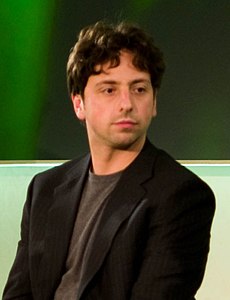
Brin immigrated to the United States from Russia at the age of six. He earned his undergraduate degree at the University of Maryland, following in his father's and grandfather's footsteps by studying mathematics, as well as computer science. After graduation, he moved to Stanford to acquire a Ph.D in computer science. There he met Larry Page, with whom he later became friends. They crammed their dormitory room with inexpensive computers and applied Brin’s data mining system to build a superior search engine. The program became popular at Stanford and they suspended their PhD studies to start up Google in a rented garage.
The Economist magazine referred to Brin as an "Enlightenment Man",
and someone who believes that "knowledge is always good, and certainly
always better than ignorance", a philosophy that is summed up by
Google’s motto of making all the world’s information "universally
accessible and useful" and "Don't be evil".
Lawrence "Larry" Page
Google |

Google AdWords
Google |

Sales and Support for Google's AdWords division is based in Mountain View, California, with major secondary offices in Ann Arbor, Michigan, the company's third-largest US facility behind its Mountain View, California, headquarters and New York City office. Engineering for AdWords is based in Mountain View, California.
Cloud computing
Google |

Internet search (search engine)
Google |
Popular Posts
-
In filmmaking and video production, footage is the raw, unedited material as it had been originally filmed by movie camera or recorded by a...
-
A touchscreen is an electronic visual display that can detect the presence and location of a touch within the display area. The term g...
-
A megapixel (MP or Mpx) is one million pixels, and is a term used not only for the number of pixels in an image, but to express the numb...
-
A smartphone is a high-end mobile phone built on a mobile computing platform, with more advanced computing ability and connectivity than a...
-
Motoblur (often stylized as MOTOBLUR ) is an Android UI replacement and push-based service focused on social networking developed by Motor...
-
GSM ( Global System for Mobile Communications , originally Groupe Spécial Mobile ), is a standard set developed by the European Telecommun...
-
QWERTY is the most common modern-day keyboard layout. The name comes from the first six letters (keys) appearing in the topleft letter r...
-
Europe ( pronunciation: / ˈ jʊər ə p / yewr -əp or / ˈ j ɜr ə p / yur -əp ) is, by convention, one of the world's seven continents...
-
OMAP developed by Texas Instruments is a category of proprietary system on chips (SoCs) for portable and mobile multimedia applicatio...


